Safety & Compliance4 June 2026

Scaffolding for Roof Repairs in Wellington: WorkSafe NZ Compliance, Pitch Rules & What You Actually Need

Everything Wellington homeowners and roofers need to know about scaffolding for roof repairs — WorkSafe NZ's 25-degree pitch rule, edge protection vs platform scaffolding, handover certificates, and pricing.

This is a background guide. For services, pricing, and a free quote visit our main Reroofing Scaffolding Wellington page — Wellington's top-rated scaffolding company, 5.0★ from 68 Google reviews, SiteWise Gold 2026/27.

Planning a roof repair in Wellington? Before your roofer sets foot on the roof, New Zealand law requires compliant fall protection to be in place. This guide explains exactly what WorkSafe NZ requires, how your roof pitch determines which system you need, what a compliant setup looks like, and how to get it organised quickly anywhere in the Wellington region.

Why Scaffolding for Roof Repairs Is a Legal Requirement in New Zealand

Under the Health and Safety at Work Act 2015 and the Health and Safety at Work (General Risk and Workplace Management) Regulations 2016, anyone doing roofing work at height has a legal duty to prevent falls where it is reasonably practicable to do so. For residential roofing — including repairs, reroofing, gutter replacement, and tile work — a fall of 1.5 metres or more is considered a significant risk, and WorkSafe NZ requires that falls be prevented, not just managed after they happen.

That means compliant fall protection must be in place before work begins. Not during. Not after. Before.

The two most common systems used for roof repair work in Wellington are:

1. Roof edge protection — a perimeter guardrail system along the eaves

2. Platform scaffolding at gutter height — a full working platform erected at eave level

Which one is required depends primarily on your roof pitch. WorkSafe NZ's guidance is specific.

---

The 25-Degree Rule: WorkSafe NZ's Roof Pitch Standard

WorkSafe NZ's guidance for residential roofing compliance is built around a critical threshold: 25 degrees of pitch.

Roof Pitch Under 25 Degrees — Edge Protection Required

If your roof pitch is less than 25 degrees, the roof is considered a low-pitch roof. On a low-pitch roof, a roofer can work on the surface itself without immediately sliding off — but they still need protection at the perimeter.

What is required: A compliant roof edge protection system — a guardrail erected along the eaves and rakes of the roof to prevent falls over the edge.

Edge protection for low-pitch roofs typically uses eave-mounted stanchions with guardrails at the required heights (900mm and 1,800mm above the working level). There is no requirement for a working deck — the roofer works on the roof surface itself, and the guardrail stops a fall at the perimeter.

Common roof types in this category in Wellington:

  • Corrugated iron and long-run metal roofing at low pitch (very common across Wellington, Lower Hutt, and Kāpiti Coast)
  • Modern low-pitch membrane roofing
  • Gentle gable roofs on bungalows built from the 1970s onwards

Typical cost in Wellington: $500 – $1,400 depending on property height and perimeter length, including erection, hire, handover certificate, and dismantle.

---

Roof Pitch 25 Degrees or More — Platform Scaffolding at Gutter Height Required

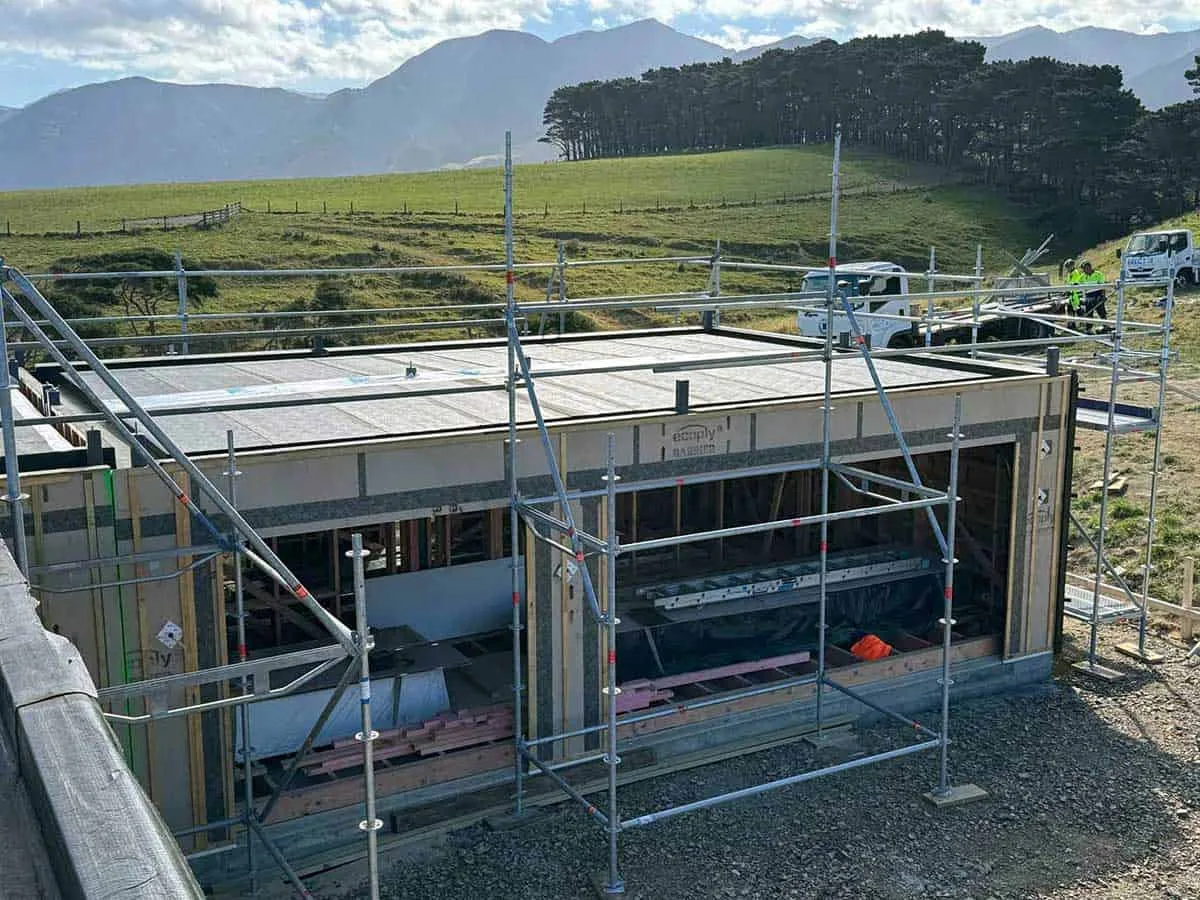
If your roof pitch is 25 degrees or greater, WorkSafe NZ requires a working platform erected at gutter height — in other words, a full scaffolding platform at eave level that surrounds the building.

This is because on a steeper roof, a roofer cannot safely work on the surface in the same way — the pitch creates a greater sliding and fall risk. The scaffolding platform serves two purposes: it provides a work and staging area at the eave, and it acts as a catch platform if a worker does slip.

What is required: A perimeter scaffolding with a working platform (planked deck) at gutter height, with guardrails above the deck at 900mm and 1,800mm. The platform must be wide enough (typically at least 450mm clear — ideally 900mm) for safe use.

Common roof types in this category in Wellington:

  • Steep corrugated iron roofing on older Wellington villas and bungalows (very common in Thorndon, Newtown, Berhampore, Kilbirnie, and the hill suburbs)
  • Concrete and clay tile roofing on steeper pitches (Khandallah, Karori, Wadestown)
  • Steeply pitched heritage roofing on pre-1940s homes
  • Steep gable and hip roofs across the wider Wellington region

Typical cost in Wellington: $1,200 – $2,500 for a standard two-storey home, including erection, handover certificate, weekly hire, and dismantle.

> Not sure of your roof pitch? As a rough guide: if your roof looks nearly flat, it's probably under 25 degrees. If it looks like a steep triangle — closer to a 45-degree angle — it's almost certainly over 25 degrees. Erect It can confirm this when we quote. We quote by roof type and visual inspection, so you don't need to measure it yourself.

---

What Is a Scaffolding Handover Certificate — and Why It Matters

Before any roofer legally starts work, the scaffolding company must provide a scaffolding handover certificate. This is a signed document confirming:

  • The fall protection system has been erected in accordance with WorkSafe NZ requirements and the relevant New Zealand Standard (NZS 8756:2021 for scaffolding or the AS/NZS 4994 series for temporary edge protection)
  • The system has been inspected by a competent person and found safe for use
  • The erecting contractor has handed responsibility for the system to the user

This certificate is not optional. A roofer who starts work without a handover certificate is in breach of WorkSafe NZ regulations. A homeowner who allows work to start without one may share liability for any incident.

At Erect It Scaffolding, the handover certificate is included with every installation — it's part of the job, not a chargeable extra.

---

NZ Scaffolding Standards: What "Compliant" Actually Means

The two key standards that govern scaffolding and temporary edge protection for roofing work in New Zealand are:

  • NZS 8756:2021 — New Zealand Standard for Scaffolding. Covers the design, erection, and inspection of scaffolding systems including platform scaffolds used at gutter height for roofing work.
  • AS/NZS 4994.1 and 4994.2 — Standards covering temporary edge protection systems, including eave-mounted guardrail systems used on low-pitch roofs.

Both require the system to be:

  • Designed and erected by a competent person with appropriate training
  • Inspected before handover
  • Accompanied by a handover certificate before use
  • Re-inspected after any significant event (storm, impact) during the hire period
  • Dismantled safely once the work is complete

WorkSafe NZ also references its own guidance document "A guide to scaffolding" (updated guidance aligned with the Health and Safety at Work Act 2015), which is publicly available and reinforces these requirements for all residential and commercial roofing work.

---

Who Is Responsible for Roof Repair Scaffolding?

Wellington homeowners often assume the roofer sorts the scaffolding. Sometimes they do — but not always. Here's the actual responsibility chain:

As the property owner, you have a duty under the Health and Safety at Work Act to ensure any contractor you engage has a safe work environment — which includes ensuring fall protection is in place before roofing work starts.

As the roofing contractor, they have their own duty to ensure the work environment is safe before they start. Most Wellington roofers will not step on a roof without compliant fall protection because their own WorkSafe obligations leave them no choice.

In practice, there are two common arrangements:

1. Your roofer includes scaffolding or edge protection in their quote and arranges it themselves (they must still provide a handover certificate)

2. Your roofer quotes for roofing only and asks you to arrange fall protection separately

Either is fine — as long as the compliant system is in place before work starts. If you're arranging it yourself, call us. We coordinate directly with your roofer on timing.

---

Common Roof Repair Scenarios in Wellington and What Each Needs

Iron Roof Repair or Replacement (Low-Pitch) — Wellington, Lower Hutt, Kāpiti

Long-run metal and corrugated iron is the most common roofing material in the Wellington region. At a low pitch (under 25 degrees), a roof edge protection system is typically all that's required. For a full reroof, a platform scaffolding is often preferred as it makes material handling significantly easier.

Tile Roof Repairs — Khandallah, Karori, Eastbourne, Wainuiomata

Concrete and clay tiles are heavy and often found on steeper-pitch roofs in the hill suburbs. Most tile roofs in Wellington are at or above 25 degrees — which means a platform scaffolding at gutter height is required. We handle this regularly across the upper Wellington suburbs.

Villa and Heritage Roof Repairs — Thorndon, Newtown, Mt Victoria

Wellington's pre-1940 villas typically have steep gable roofs — often 35–45 degrees. These almost always require a platform scaffolding at gutter height. Heritage properties may also require care around eaves and guttering — our crew is experienced working on heritage buildings where standard fixings can cause damage.

Roof Leaks and Patch Repairs — Any Suburb

Even a small patch repair or a single sheet replacement requires compliant fall protection if the roof is at height. A roofer spending 20 minutes on a repair is just as exposed to fall risk as one doing a full reroof. There are no exemptions for small jobs.

---

What Does Scaffolding for Roof Repairs Cost in Wellington?

SystemPropertyTypical Price
Edge protection (< 25° pitch)Single-storey$500 – $900
Edge protection (< 25° pitch)Two-storey$900 – $1,400
Platform scaffolding (≥ 25° pitch)Single-storey$800 – $1,200
Platform scaffolding (≥ 25° pitch)Two-storey$1,200 – $2,500
Hill access surcharge (Wellington steep sections)+$200 – $500
Weekly hire rate (after initial period)$80 – $300/week

All prices include erection, the handover certificate, and dismantle. We quote within 24 hours — call 027 886 6688 or fill in our quote form →.

---

How to Organise Scaffolding for Roof Repairs in Wellington

1. Confirm with your roofer whether they supply their own fall protection or need you to arrange it

2. Know your roof pitch — roughly flat or shallow (likely under 25°) vs. clearly steep (likely 25°+). If unsure, we'll confirm when we quote

3. Call Erect It on 027 886 6688 (or request a quote online →) — tell us your address, approximate roof size, and your roofer's planned start date

4. Receive a fixed quote within 24 hours

5. We erect and issue the handover certificate before your roofer starts — we coordinate directly with them

6. We dismantle promptly when the job is done

---

Frequently Asked Questions

Does every roof repair need scaffolding in New Zealand?

Yes, if the work involves a fall risk of 1.5 metres or more — which includes virtually all work on residential roofs. There are no exemptions for small or short-duration jobs. The duty to prevent falls applies regardless of how long the roofer is on the roof.

How do I know if my roof is above or below 25 degrees?

As a rough guide: most modern homes with a shallow or gentle pitch are under 25 degrees. Older Wellington homes — particularly villas, bungalows, and homes in the hill suburbs — often have pitches of 30–45 degrees, well above the threshold. If you're unsure, we can confirm the pitch type from your address and a quick look. We won't charge you for a wrong call on pitch type.

Can my roofer erect their own edge protection?

Yes — some roofing contractors carry and erect their own edge protection systems. If so, they must be competent to erect it correctly and must provide their own handover certificate before starting roofing work. Ask to see the certificate.

Does the platform scaffolding need to be on all four sides?

For a full perimeter roof, yes — platform scaffolding or edge protection must protect every exposed edge where a fall could occur. For a simple lean-to addition or a roof with only one elevated edge, the requirement applies to the exposed edges only.

How quickly can you install scaffolding for a roof repair in Wellington?

For a standard Wellington property, erection takes a half to one day. We can typically be on site within 24–48 hours of a confirmed booking. For urgent jobs — roofers with weather windows — call us directly on 027 886 6688 and we'll do our best to move fast.

Do you cover the whole Wellington region?

Yes. We cover Wellington City, Lower Hutt, Upper Hutt, Porirua, Kāpiti Coast, Wairarapa, Horowhenua, and everywhere in between. No travel surcharge across our core service area.

---

Erect It Scaffolding — Wellington's Roof Repair Scaffolding Specialists

Erect It Scaffolding is the Wellington region's most trusted scaffolding company for roof repair and reroofing work.

  • 5.0 stars · 68+ Google reviews
  • SiteWise Gold accredited 2026/27
  • Handover certificate included on every job — no extra charge
  • Free quotes within 24 hours · Erection within 24–48 hours of booking
  • Based in Plimmerton — no travel surcharge across Greater Wellington, Lower Hutt, Kāpiti Coast, and Wairarapa

Whether your roof is a gentle low-pitch iron job in Porirua or a steep heritage villa in Thorndon, we'll have the right compliant system in place before your roofer starts.

Call Dhillon on 027 886 6688 or request your free quote →.

---

Need scaffolding hire in Wellington? Visit our dedicated scaffolding hire Wellington page — every service, suburb, and price guide for the Wellington region.

Need scaffolding for your project?

Get a free, no-obligation quote from Greater Wellington's SiteWise Gold 2026/27 certified scaffolding specialists.